
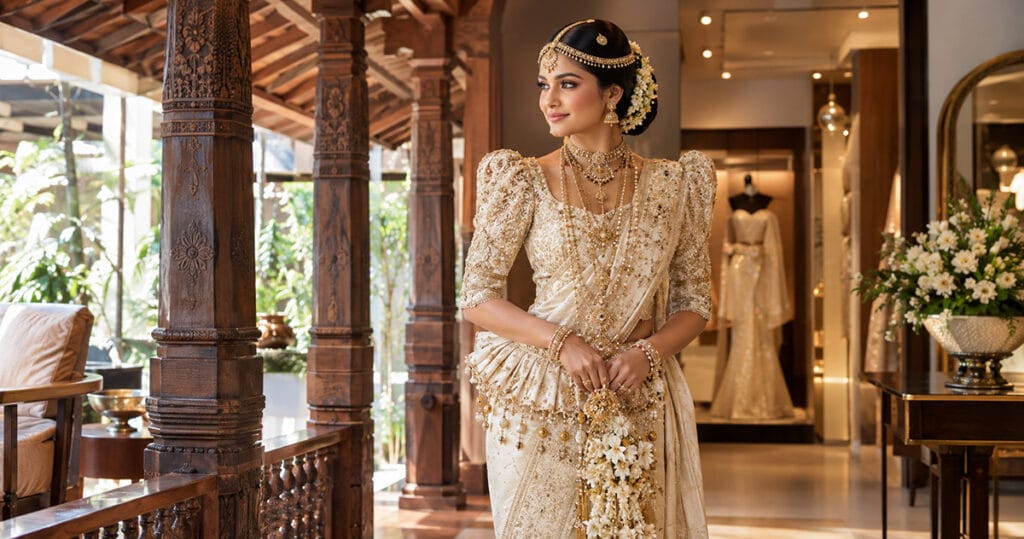
The Kandyan Saree, locally known as the Osariya, is undeniably the most recognizable symbol of Sri Lankan feminine grace and cultural heritage. Far more than a mere draping style, it is a living, breathing tapestry that intertwines the island’s royal history, the unique social fabric of the Kandyan highlands, indigenous craftsmanship, religious rituals, and deeply rooted wedding traditions.
While the Sinhala term Osariya is widely used among locals, it is globally recognized and searched for in English as the “Kandyan Saree” or “Kandyan Dress.” Although this majestic attire is intrinsically tied to the Kandyan Kingdom, tracing its exact origins reveals a complex history. Historians and fashion anthropologists suggest that the modern Kandyan Saree is a beautiful amalgamation of indigenous clothing styles, South Indian draping techniques, the influence of the Nayakkar dynasty, and subtle structural changes introduced during the European colonial eras [archive.roar][seu.ac][mdpi].
What Does the Name “Osariya” Mean?
At its core, the Osariya is a distinctive draping method where a lengthy piece of fabric is wrapped around the lower body, with a specific section arranged to flow gracefully over or near the shoulder. When compared to the standard Indian ‘Nivi’ drape, the defining hallmark of the Kandyan Saree is the voluminous, ruffled section that rests elegantly at the side of the waist.
This iconic ruffled waist section is known by various regional and familial terms, including the Odokkuwa, Neriya, Frill, or Ina Rali (waist pleats). According to traditional accounts, the drape is meticulously constructed by narrowing one end of the saree to fall over the shoulder, wrapping the remaining fabric securely around the waist, and gathering a portion to create this signature frilled structure [exploresrilanka][thecultural].
Tracing the Origins: Main Historical Theories
1. The Connection to the Kandyan Kingdom
Today, the Osariya is synonymous with the “Kandyan Saree” largely because it is deeply intertwined with the royal and social culture of the Kandyan Kingdom—Sri Lanka’s last independent monarchy, which stood until 1815. Evidence of the attire worn by queens, royal concubines, and elite women during this era can be observed in historical paintings, temple frescoes, foreign travelers’ logs, and preserved palace traditions [seu.ac][dl.lib.uom].
However, claiming that the fully formed Kandyan Saree we see today existed precisely in the same format during the early Kandyan era requires historical nuance. Elite women’s clothing during that time included the Ohoriya, fitted jackets, long lower garments, shoulder cloths, and heavy ornaments. Over centuries, these individual elements evolved, gradually fusing into the silhouette of the modern Kandyan Saree.
2. The South Indian Influence
Several researchers propose that earlier draping styles like the Ohoriya may share historical links with South Indian—particularly Tamil—draping methods that utilized unstitched lengthy fabrics. Renowned art historian Ananda K. Coomaraswamy once noted that the Ohoriya likely possessed South Indian or Tamil roots.
There is a prevailing theory that certain elements of the Kandyan Saree represent a fusion of draping techniques like the Ohoriya and the Selai. Yet, simply categorizing the Kandyan Saree as a “foreign import” is historically inaccurate. Sri Lanka has always been a vibrant hub of Indian Ocean trade, political alliances, and royal marriages. Thus, foreign cultural elements were naturally absorbed and reshaped to suit local climates, aesthetics, and social requirements.
3. The Impact of the Nayakkar Dynasty
The 18th century, under the rule of the Nayakkar kings in the Kandyan Kingdom, is widely considered a pivotal era in the evolution of the Kandyan Saree. The Nayakkar dynasty held strong South Indian ties, which naturally introduced Dravidian influences into palace fashion, fabrics, jewelry, and hairstyles.
Therefore, it is most accurate to understand the modern Kandyan Saree as a masterful blend of indigenous Kandyan styles and Nayakkar-era South Indian influences. Its final form was not invented overnight but is the result of generations of cultural adaptation.
Historical Attire During the Kandyan Era
To fully grasp the sartorial culture of the Kandyan Kingdom, one must look beyond the Osariya to the diverse garments used during the period. Research sources indicate that the attire of royal and elite women comprised several distinct components:
- A fitted upper garment or jacket.
- Long lower cloths resembling a sarong or saree.
- The Ohori Pota (fabric draped over the shoulder).
- Shoulder wraps such as the Lansoluwa.
- Head coverings like the Mottakkiiliya.
- Elaborate jewelry, including necklaces, earrings, bangles, armbands, and waist ornaments.
- Imported exotic fabrics reserved for special occasions.
Records also show that Kandyan royals frequently wore imported fabrics received as diplomatic gifts or acquired through trade. Thus, the “traditional Kandyan dress” was born from a dynamic intersection of localized tailoring and international maritime trade [uom].
Anatomy of the Kandyan Saree: Key Components
While traditionalists still drape a single, unstitched saree fabric to create the look, modern tailoring has popularized the “Made-up Osariya” (pre-stitched Kandyan Saree), which divides the garment into distinct, manageable pieces.
The Jacket (Hattaya / Blouse)
The upper garment of the Kandyan Saree is commonly referred to as the Hattaya or jacket. Key characteristics of a traditional jacket include:
- Full coverage of the chest and midriff, promoting modesty.
- A heavily tailored, form-fitting silhouette.
- Short or three-quarter sleeves, most famously the gathered “puff sleeves”.
- High necklines, round necks, or heavily embellished collars.
- Intricate detailing using lace, beads, sequins, embroidery, and gold thread.
Compared to a standard Indian saree blouse, the Kandyan jacket offers significantly more coverage, historically symbolizing modesty, formality, and feminine dignity.
The Shoulder Drape (Pota)
The fabric that cascades elegantly over the left shoulder is known as the Pota or Pallu. In traditional settings, the length, width, and pleating of the Pota are strictly monitored. For bridal wear, the Pota is heavily ornamented with golden borders, intricate embroidery, and pearl beadwork. The way the Pota is pinned dramatically affects the bride’s height perception and overall posture.
The Waist Structure (Neriya)
In the pre-stitched (made-up) version, the piece fastened around the waist is called the Neriya. It acts as a structural foundation, taking on a peplum-like shape that seamlessly bridges the gap between the jacket and the lower skirt, often decorated with borders or lace.
The Side Frill (Odokkuwa)
The most distinguishing feature that sets the Kandyan Saree apart from all other global drapes is the side frill or Odokkuwa. Projecting forward from the side of the waist, it grants the attire a voluminous, regal appearance. The size and pleat count of this frill vary by region and designer, but for a bride, it is structured to be a prominent focal point.
The Underskirt (Mul Anduma)
Worn beneath the saree, the Mul Anduma (underskirt) is crucial for providing shape and volume. Its primary functions include holding the saree’s shape, supporting the heavy side frill, preventing the fabric from clinging to the legs, and ensuring the bride can walk gracefully.
Waist Jewelry
Especially prominent in a Kandyan bridal saree, a waist chain or belt—sometimes referred to regionally as an Araliya Pettiya or simply an Ina Patiya—is worn over the waist. This jewelry secures the saree in place while adding a rich layer of gold, silver, pearls, or gemstones to the ensemble.
Traditional Draping vs. The Modern “Made-Up” Saree
Though slight regional variations exist, the traditional hand-draping method involves securing the underskirt, pleating and placing the Pota over the left shoulder, wrapping the remaining fabric twice around the waist, and meticulously gathering a section at the side to form the Odokkuwa frill.
Today, the pre-stitched or “made-up” Kandyan Saree is highly preferred by modern brides. It is effortless to wear, ensures the pleats do not unravel during long ceremonies, and retains its perfect shape. A modern made-up Kandyan Saree separates the jacket, the shoulder drape, the Neriya, and the lower skirt into independent, perfectly tailored pieces [trekkingincouture.wordpress].
Unique Characteristics of the Kandyan Saree
- The Side Frill: Unlike the standard saree which features front pleats, the Kandyan drape’s side frill creates movement and a sense of architectural fashion.
- Complete Midriff Coverage: Making it the preferred attire for formal, religious, and state events.
- Puff Sleeves: A hallmark of Kandyan bridal wear, drawing attention to the shoulders.
- The Three-Piece Illusion: Even when hand-draped from a single cloth, the styling creates the illusion of three distinct garments.
[exploresrilanka] - A Regal Silhouette: The balance between the shoulder, waist, and lower skirt elongates the body, offering a dignified posture.
The Complete Bridal Look & Jewelry
A Kandyan bridal saree is incomplete without its legendary traditional jewelry set. This head-to-toe ornamentation includes the Nalalpata (headpiece), heavy earrings, multi-tiered necklaces (such as the Hansaputtuwa), armbands, bangles, and waist belts. Often accompanied by elaborate floral hair arrangements, this complete system is widely celebrated as the “Kandyan Bridal” look [serendipevents][poruwa].
In traditional Sinhalese weddings, particularly during the sacred Poruwa ceremony, the Kandyan Saree symbolizes family heritage, prosperity, and social dignity. While traditional brides opt for white, cream, or gold to represent purity, modern brides frequently experiment with maroon, red, or soft pastels based on personal preference and fashion trends.
Evolution: Colonial Impacts and Modern Fashion
During the Portuguese, Dutch, and British colonial eras, European tailoring elements—like corsetry, lace, puff sleeves, and buttons—merged with local styles, creating a complex sartorial hybrid. By the 20th century, the Kandyan Saree emerged as a symbol of national identity, proudly worn by teachers, politicians, and women across urban centers like Colombo.
Today, Sri Lanka’s handloom industry plays a vital role in preserving this heritage, employing techniques passed down from royal weavers [mdpi]. Concurrently, modern designers are pushing boundaries by introducing sheer sleeves, capes, minimal borders, and digital prints. Social media platforms like Instagram and TikTok have propelled the Kandyan Saree onto the global fashion stage.
Preserving the Heritage
The Kandyan Saree faces modern challenges: the art of traditional hand-draping is slowly fading, and commercialization sometimes overshadows its historical depth. To protect this living heritage, it is vital to document traditional draping methods, support local handloom artisans, and conduct university-level research to preserve not just the fabric, but the social context of the attire [dspace.lib].
Conclusion
The Kandyan Saree is a majestic bridge between Sri Lanka’s royal past and its vibrant present. Influenced by indigenous roots, South Indian traditions, and European tailoring, it stands today as a unique cultural language. Its signature frills, modest coverage, and regal silhouette make it a masterpiece of South Asian fashion.
Finding the perfect balance between this rich historical tradition and modern bridal aesthetics requires true expertise. At Lassana Saree in Maharagama, we specialize in honoring the authentic Kandyan heritage while catering to the modern bride. Whether you are looking for custom-tailored bespoke designs, premium first-rent options, or expert styling consultations, our dedicated team ensures your Kandyan Saree is draped to perfection, making you feel elegant, comfortable, and truly regal on your special day.